
Getting Started with Data Governance
- Data Governance
- What is Data Governance?
- Data Governance Objectives and Challenges
- Getting Started with Data Governance
- Data Governance Frameworks
- Data Governance Platforms
A data governance initiative will involve embedding various practices, processes and standards in a lot of places. The scope of this is generally proportional to the size of your organisation. You will be more successful in scaling this work if you move general activities to departmental or team level resources. This allows you to establish data owners who are close to the data. This will be more productive and risk averse than a central team who are less familiar with the data. With that in mind, let’s look at how we get your data governance started.
Stakeholders
As with any initiative across an organisation, having strong business buy-in is essential for things to gain and maintain momentum. Without this, your data governance program will likely lack acceptance and struggle to add the necessary value expected.
A good start is to identify initial resources and key personnel who will drive progress and set up the communications channels between these parties. These stakeholders must have a vested interest in the overall success of the program. Start with those who are already involved in data architecture, legal aspects of data ownership, and data infrastructure management. They may well already be making noises about what they’d like to see happening which is great. Then, look to the business for those who will really back the program. Those who really appreciate the potential for improving business capabilities through better data governance are ideal. After all business capability improvement is at the heart of every well considered data governance program. Aim for at least as many business people as you have from elsewhere within the organisation as these will help champion the program with the wider audience.
With communications approaches and stakeholders identified you can start working towards formulating the content of the data governance program.
Data Domains
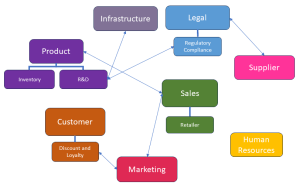 Your organisational data can be shown to exist within conceptual groupings referred to as ‘data domains’. Your organisation may have already established what these are if you have an enterprise data model or a mature data architecture or modelling practice. They will generally align well to departmental functions, with possible additional core domains such as Customer or Product that may span multiple departments. This should help you think about your structure for delegating and dividing the work across teams. A ‘data domain model’ is a great tool to help you understand how your data can be grouped for governance ownership considerations. Even if it is very high level and boundaries are rather fuzzy this view of your ‘problem space’ will help with the ‘divide and conquer’ mindset.
Being able to conceptualise your data estate into say 10-20 such groups, some of which may underlie a number of others, is invaluable.
You can arrive at a first draft data domain model through one or two workshops with relevant business owners. One technique to help arrive at this is using ‘functional decomposition’ of your organisation to identify business capabilities. These may align well to departmental views depending on the nature of your data. It is advisable is to keep your model high-level, avoiding it morphing into a data integration architecture diagram or similar. You can include ‘subdomains’ to help with the next level of detail, but lower levels will generally not prove beneficial for this exercise. Even in a draft form it will provide a much appreciated guide to understanding your data governance landscape.
Teams and Oversight
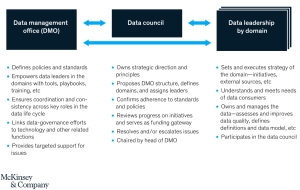
Establishing a team structure that works best for the program is critical to success and productivity. Each organisation will differ in this regard, although there are some common structures that make sense to consider. The following organisational elements are recommended from McKinsey & Company.
©2020 McKinsey & Company
Data Management Office
Although data ownership can be delegated and transferred to domain-based teams, the management of that data is a discipline that will span the organisation. The data management office exists to ensure that all aspects of ownership and processing of data follow established best practices. This may currently informally exist as a group of data architects and data strategists, infrastructure and operations team leads and similar managers.
Data Council
A central guidance authority that oversees the program will generally be required in any initiative on data governance. This data council will sit across all teams, providing consistency and coordination. It also addresses high-level aspects of the program, such as funding and issue escalation. It may include key stakeholders from the business as well as heads of data such as the Chief Data Officer (CDO) or Chief Information Officer (CIO) and related legal officers. The Chair of the council may be the head of the data management office, although having a senior business figure as chair will work better if business backing needs to be improved.
Domain Teams
How you structure your delivery teams is going to depend on various factors, including organisational culture and existing structures. You may decide on some central teams that provide supporting roles, and then further teams that address data domains. You may instead structure your teams around the different key objectives we talked about in an earlier post Data Governance Objectives and Challenges, such as legal, security etc. although this can detract from a business value driven program. With data domain teams established that are supported by specialist teams you are able to focus on meeting governance requirements that align to business data processes.
Strategy
Principles
Before you can really start to determine what to include, you’ll need a set of principles on which to base your program. Just saying ‘doing data governance’ isn’t going to get you far when it comes to formulating priorities and content later on. You should be looking to add new business capabilities through the actions of the program, thereby ensuring business value. A great way to determine a strategy, as suggested by John Ladley in his book on Data Governance is to list the principles that are basically answering the question ‘What are we trying to achieve?’ in applying data governance to your organisation. In our previous post we talked about ‘Key Data Governance Objectives’ and these should help guide you here. These principles may be relatively common ones, such as ‘Data/Information Quality’ and ‘Risk Management’, or they may be more aligned with a particular aspect of the organisation that needs addressing. They should serve to guide thinking and help justify courses of action.
Policies
From your handful of principles you can then look as determining policies to essentially reinforce and realise these. These policies then form a backbone for commonality across business areas and ensure consistency and quality throughout the program with minimal concern for deviation. As with many aspects of the program, these will evolve over time, but having a good set of core policies in place helps add structure and guidance to initial efforts.
Requirements Gathering
 There are some great reference materials on what constitutes data governance and how to go about formulating a program, as we discuss in a later post on Data Governance Frameworks. Once you understand the key constituents, decide with your stakeholders on the relative priorities.
Some organisations may try and determine an all encompassing plan from day one. As well as being a truly overwhelming task this ‘all requirements upfront’ approach will involve significant rework and ‘planning churn’. This may be familiar to those taking a ‘Waterfall’ approach to implementation. Stakeholders may understandably be less than happy with the increase lead time and reduced productivity and value resulting from this.
Agile Requirements Management
Those familiar with Agile software development understand how this approach tends to cut waste and keep requirements relevant. Let’s take a look the benefits of an Agile approach to data governance requirements management.
Why Agile?
One key advantage to an Agile approach is that on each cycle of work the priorities and risks to successful implementation are revisited. The high priority work with the best chance of getting implemented during that cycle is given preference. Those elements that have requirements that are less well defined or understood are refined based on priority. Details are gathered to understand enough to reach a level where the risk to implementation is acceptably low. By defining the details only when the items are confirmed as needed we avoid thrashing out details too early. This avoids those items that may turn out to not actually be required or have changed requirements. Waste and lead time are reduced and items are prioritised and delivered as required. This approach has real benefits with regard to progress, maintaining momentum and generally delivering value early and as needed.
The ‘Agile mindset’ may however be something that exists only within development teams within the organisation if at all. As such if this approach is to be employed there may be a need to ‘win over’ or at least explain the benefits of this way of working.
Determining Your Agile ‘Epics’
 If you do decide to work in an Agile fashion, when starting your backlog of Epics, bear in mind that despite the name these Epics shouldn’t be huge. Taking each of the objectives in our previous article Data Governance Objectives and Challenges as an Epic would probably be too broad. You could however arrive at a number of Epics within each of these areas, also having ones that span these objectives. Some of your Epics may be foundational items that are required before you can build further, such as establishing a communication approach for the program, or determining a high-level data domain model.
It is relatively easy to determine initial high level ‘Epics’ on the key areas of the program. These are then drilled into to provide a number of ‘Features’ that will form the functional elements of the program. The backlog of these items will evolve and expand over the course of the program. Changes in regulation, security, and internal demands for data will direct the workload over time. This is the nature of the program of work and working Agile will complement this shifting nature. Once you have agreed some of the details for these backlog items you will be able to get your data governance initiative started.
Conclusion
Embarking on your data governance journey doesn’t have to be a planning behemoth or feel like herding cats. With a small group of stakeholders and understanding of how your data estate needs to relate to the business you can start the ball rolling. Agile practices will help to provide value early and prove to the organisation that data governance works at all levels. As we continue this series, we’ll take a brief look at some of the frameworks and technologies that can help you achieve your goals.
Moving You Forward with Data Governance
If you’d like to understand more about getting started with data governance please don’t hesitate to get in touch. Our data governance service is a flexible, coworking approach that provides assistance wherever you are on your journey.

Nigel Meakins administrator
Having worked for many years in the world of data and analytics, I enjoy following new innovations and understanding how best to apply them within business. I have a broad technical skill set and an acute awareness of how to make Agile work on data projects. Working at all levels and in a variety of roles on projects, I help our clients understand how the latest technology can be applied to realise greater value from their data.






About the author