
Data Governance Frameworks
The implementation of a data governance program involves a number of capabilities and disciplines. We have spoken about key objectives and some common challenges. We’ve also discussed approaches to progressing with the work. Data governance is certainly not new, and as such there are considerable bodies of work that will help with your efforts. For something as involved as data governance, even in smaller organisations, we can look to frameworks to guide our efforts.
In this post we’ll summarise the most common data governance frameworks to help you determine their applicability for your initiative. Their content should be viewed as elements for probable inclusion, with varying priorities across different organisations and business sectors. They may help you determine team structures and will definitely form various implementation areas for backlogs and roadmaps. As we talked about previously, look to roll these out over time based on understanding of requirements, stakeholder priorities and ability to execute.
Summary of Popular Data Governance Frameworks
Provided here is a short summary of each of the featured frameworks and a list of their components to assist you with deciding on which you may want to consider. Each brings their own unique take on the subject. They offer valuable insight into what lies ahead and will help considerably with structuring your approach.
DAMA DMBOK
The DAMA Data Management Body of Knowledge (DMBOK) is available for purchase from DAMA International. As you would expect from DAMA, it is a well structured and detailed resource that is well worth the admission price. At nearly 600 pages, it is an all-inclusive guide to data management. It comprises a data management framework composed of the items below:
- Data Governance
- Data Architecture
- Data Modeling and Design
- Data Storage and Operations
- Data Security
- Data Integration and Interoperability
- Document and Content Management
- Reference and Master Data
- Data Warehousing and Business Intelligence
- Metadata Management
- Data Quality Management
- Big Data and Data Science
© 2017 DAMA International
Data Governance is seen to be the central theme that touches all elements of data management.
The data governance program is further shown as a set of processes and disciplines that surround and influence data management foundational activities and lifecycle management.

These areas will undoubtedly feature to a greater or lesser extent within your own data governance efforts. Each organisation will seek to tailor their efforts according to business need and gaps.
The section on data governance includes steps for implementation as below:
- Assess their current data management maturity
- Identify gaps and areas for improvement
- Develop a roadmap for implementation
- Assign roles and responsibilities
- Provide training and support
- Monitor and measure progress
© 2017 DAMA International
This provides a robust approach to defining and assessing progress of your data governance program against a proven framework. It is a popular choice, being applicable to organisations of varying size. You can find the DAMA DMBOK on Amazon (other booksites are available) or the DAMA International store at https://technicspub.com/dmbok2/.
DAMA also provide images of each of the areas of the framework from the DMBOK for download, available at https://www.dama.org/cpages/dmbok-2-image-download. An example is given below for the data architecture aspects.

The Data Governance Institute Framework
This body exists to provide guidance and expertise on implementing data governance. They have been around for 20 years and offer a huge amount of incredibly insightful material and practical advice around how to succeed in data governance. Their data governance framework moves the focus away from familiar aspects of data management and towards more governance “rules of engagement”. The majority of their articles are free, with a small number of more specialised articles requiring a modest subscription to access. The various components are listed below:
- Mission and Value
- Beneficiaries of Data Governance
- Data Products
- Controls
- Accountabilities
- Decision Rights
- Policy and Rules
- Data Governance Processes, Tools, and Communication
- DG Work Program
- Participants
This is arranged into the framework as shown below.

There are additional articles on aspects such as funding models for data governance, how focus areas may differ in programs, governance models and more. In essence just about every aspect of the initiative is considered. Even if you decide not to use this framework their articles are definitely worth a visit and not at all heavy going.
IBM Data Governance Council Maturity Model
This free resource is focused solely on data governance as a discipline and how to grow this within the organisation. It also uses the concept of a ‘Maturity Model’ to assess capability and track progress. Although only 16 pages it still manages to provide a valuable structure upon which to base your initiative. The concept of data governance is divided into eleven framework elements or ‘domains’, as listed below:
- Organisational Structures and Awareness
- Stewardship
- Policy
- Value Creation
- Data Risk Management and Compliance
- Information Security and Privacy
- Data Architecture
- Data Quality Management
- Classification and Metadata
- Information Lifecycle Management
- Audit Information, Logging and Reporting
Some of these are similar to those within the DAMA DMBOK, although concepts outside data management are also included. These are grouped into functions of Outcomes, Enablers, Core Disciplines and Supporting Disciplines as shown below.
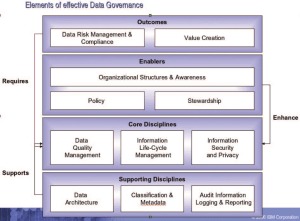
This provides an intuitive view of how elements interact and will assist with planning and prioritising work. When drilling down into the various areas of the model you will however need to consult other more specialised resources to determine implementation details.
CMMI Data Management Maturity Model (DMM) – Discontinued
This is no longer in service, having been discontinued recently. If you are using CMMI approaches to oganisation management you may find aspects that can be applied to data management, however there is no longer a specific model provided.
Implementing a Data Governance Framework
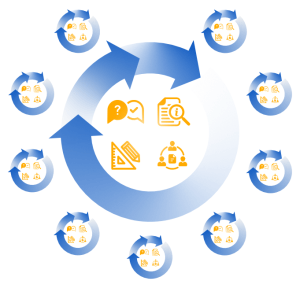 In the interests of reducing lead-time and delivering value early and often, as previously mentioned in Getting Started with Data Governance an Agile delivery method works well. To recap on the points we previously made, focusing on high-priority items that have a low risk of not being delivered with your work iterations will allow progress in the areas that matter most. If an area is required urgently but is poorly defined, focus on bringing the definition of requirements to a level that allows work to move forward as soon as possible. Once items start being delivered, momentum and enthusiasm will build, helping to drive further value.
Applying Data Governance in Small to Medium Enterprises (SMEs)
The need for some degree of data governance will be required in organisations wherever data exists, regardless of size. For an organisation owning and processing only a very small amount of ‘low-risk’ data, a smaller program may suffice. A very light touch program prioritising on data security and operations for example may address most concerns. Obviously larger organisations with larger data estates will require more aspects to be covered in greater depth and breadth. It may prove unfeasible to try and cover all aspects of a framework within an SME, however all aspects should be discussed and prioritised accordingly. A reduced framework for initial delivery can then be defined and added to as needed. Items from the DAMA DMBOK worth considering as a first pass for SME data governance frameworks might include:
- Data Governance
- Data Architecture
- Data Storage and Operations
- Data Security
- Data Warehousing and Business Intelligence
- Data Quality Management
You will still want to consider the benefits of establishing a Data Management Office (DMO) and identifying data domains and their respective leaders/owners. The remit of the DMO and the size and number of the data domains will be scaled down but still provide essential functions.
A great reference for considering data governance frameworks for SMEs can be found at https://cornerstone.lib.mnsu.edu/cgi/viewcontent.cgi?article=2125&context=etds, in the form of a thesis submitted for an MSc in Data Science. It also provides a good overview of recent data legislation to be aware of.
Further Reading
The Data Governance Institute has a great round-up of books on data governance.
https://datagovernance.com/bookstore/
In particular “
The DAMA DMBOK website also includes a list of books referenced in the various chapters of the DMBOK. Having them available by chapter makes for another great (although large) browsable list of possible reading material.
https://www.dama.org/cpages/books-referenced-in-dama-dmbok
Summing Up
We hope you found the above overview of data governance frameworks helpful for initiating or progressing your program. Having talked about people and process aspects, we’ll be looking next at data governance technology considerations.
Defining Your Data Governance Initiative
If you’d like guidance and help on any areas of data governance please don’t hesitate to get in touch. Our data governance service is a flexible, coworking approach that provides assistance wherever you are on your journey.

Nigel Meakins administrator
Having worked for many years in the world of data and analytics, I enjoy following new innovations and understanding how best to apply them within business. I have a broad technical skill set and an acute awareness of how to make Agile work on data projects. Working at all levels and in a variety of roles on projects, I help our clients understand how the latest technology can be applied to realise greater value from their data.




About the author